
Candidate of Philosophical Sciences, Associate Professor L.V. Arutyunyan, in his article “The Armenian Trace in the Origin of the Thessalonian Brothers,” attempted to prove that the creators of the Slavic alphabet, Cyril and Methodius, have Armenian roots. Below is the full article with references cited.
“Among contemporary Slavists, there is no consensus on the origin of the creators of the Slavic alphabet, the brothers Cyril and Methodius. It is only definitively proven that their origin was non-Slavic. Other proposed theories, in particular regarding a Bulgarian origin of the brothers, also do not seem convincing.
The aim of this article is, based on an analysis of the biographies of Cyril and Methodius, to trace the Armenian influence in their origin.
The role of writing in human history in general, and in the history of individual peoples in particular, requires no discussion. The creators of writing systems—cuneiform, hieroglyphs, alphabets—made enormous contributions to preserving the culture and history of peoples, thereby immortalizing their own names. For the oldest writing systems, the names are collective: Egyptians, Sumerians, Phoenicians, Persians, Chinese, Jews, Greeks, Romans, Indians, etc. Only some writing systems have known individual creators. Among the Slavs, these are the brothers Cyril and Methodius; among Armenians, Mesrop Mashtots.
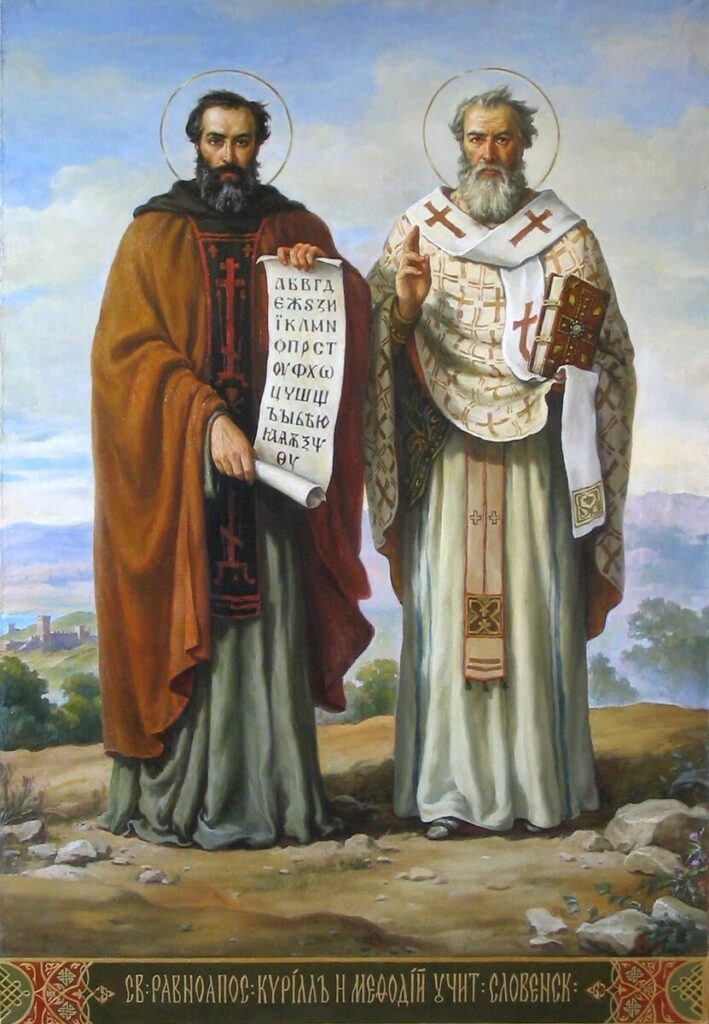
The Thessalonian brothers share many similarities with Mesrop Mashtots. They created an alphabet that allowed their peoples to read the Holy Scriptures in their native tongue, were canonized as saints, venerated, and for many years preached Christianity. And these names, paradoxically, despite being separated by nearly five centuries, are closely connected. In modern Slavic studies, the non-Slavic national origin of the alphabet’s creators is considered proven, while their Greek origin is denied [6, pp. 105–106].
One widespread theory is that the Thessalonian brothers, Cyril and Methodius, were of Bulgarian origin. However, the Bulgarian ethnicity, as is known, formed through the merging of Turkic and Slavic elements. The Proto-Bulgarians arrived in the Balkans in the 7th century AD, when some Turkic tribes migrating along the lower Volga and Don moved to the Balkans, and others settled in the upper Volga region, founding the so-called Volga Bulgaria. The process of Slavicization of the Bulgarians was complex and lengthy, lasting at least a dozen centuries. Therefore, it is unlikely that by the early 9th century anyone among the Bulgarians would have been Christian and engaged in educational efforts, the creation of writing, or the Christianization of the Slavs. And why would the Turks need a Slavic alphabet when a Turkic one did not yet exist?
Thus, the Bulgarian origin theory for the Thessalonian brothers does not hold up to scrutiny. More importantly, Cyril and Methodius themselves never mentioned it: they did not remember, did not know, and did not speak of any Bulgarian origin, but they did remember, know, and speak of their ancestors, close to the Byzantine emperors, and of their Byzantine heritage. So who were they?
In academic circles, there is also the hypothesis of Armenian origin for the creators of the Slavic alphabet—the Thessalonian brothers Cyril and Methodius. This version was proposed by Academician Artashes Andreevich Artsruni.

A.A. Artsruni is a prominent Russian scientist, metallurgist, analyst, and inventor who worked for nearly forty years in the Russian defense industry. He is known as the creator of Russian aluminum tank armor. However, Artsruni’s scientific and life interests extend beyond his professional work and include linguistics, culture, and history. He is the author of several books on comparative linguistics and Armenian culture. His works are full of fresh perspectives and ideas, often challenging established views, while remaining serious, scientific, and well-argued. Artsruni presents a new perspective on the Byzantine roots of the Slavic alphabet and the ethnic identity of its creators, Cyril and Methodius. His approach, based on the defining influence of Christianization and Christian symbolism on the construction of post-Christian writing systems, allowed Artsruni [3] to uncover the structure and principles of the first Christian alphabet in the world—the Armenian alphabet of Mesrop Mashtots—and to demonstrate the fundamental unity in the construction of the Armenian and Slavic (Glagolitic) alphabets. He also showed the role of Armenian writing in the formation of the current Slavic script—Cyrillic.
Cyril and Methodius were born into the family of a mid-level Byzantine provincial military commander—a drungary (centurion) named Leo and his wife Maria. Their father died no earlier than 841.
Methodius (815–885) was the elder son. His probable birth name was Michael. He entered military service and around 835 was appointed governor of one of the Slavic regions (the Theme of Strimon), where he served about ten years. He then left secular life, became a monk, retired to a monastery, and by the end of his life was elevated to the rank of bishop.
The youngest of seven children in the family, Constantine (827–869), adopted the monastic name Cyril after a severe illness, fifty days before his death, as he faced his mortality. From childhood, he was noted for his literacy and linguistic talent. After his father’s death, Constantine was taken under the wing of the head of the imperial chancellery, Logothete Theoctistus, who later became regent for the young heir Michael III. Constantine studied alongside the young emperor in the imperial higher philosophical school, Magnaura. His great-grandfather served as a model: Artsruni quotes him as saying, “I want to accumulate knowledge, seek the honor and wealth of my great-grandfather” [1, p. 37].
Soon, Constantine became chartophylax—the patriarchal librarian at the main cathedral of Byzantium, Hagia Sophia of Constantinople—and later a teacher at Magnaura. He gained fame as a leading philosopher-polemicist, philologist, and theologian, and quickly acquired the nickname “Constantine the Philosopher.”
Arguments supporting the Armenian origin of the Thessalonian brothers include information about the Magnaura school and its first rector, Leo the Mathematician, as well as about the imperial family and Empress Theodora.
The Magnaura school was established in Constantinople through the efforts of Priest Hovhannes Kerakan (John the Grammarian), nicknamed for his great learning. His name first appears during the reign of Byzantine Emperor Leo V the Armenian (813–820) in connection with iconoclasm. In 814, by the emperor’s order, the then little-known Armenian Hovhannes prepared a scientific-dogmatic justification of iconoclasm, which he successfully presented. John the Grammarian became best known as Patriarch John VII of Constantinople (837–843), corresponding to the time when the younger brother, Constantine, arrived in Constantinople. Cyril (Constantine), the future creator of the Slavic alphabet, studied and later taught at Magnaura. According to the monk Chernorizets Hrabar, he created the Slavic alphabet at Magnaura, initially comprising 36 letters, as in the Armenian Aybuben [7].

R.V. Ter-Ghazaryan demonstrates that Leo (Levon) the Mathematician, professor of philosophy and nephew of John the Grammarian—Metropolitan of Thessaloniki during 840–842 (hence likely acquainted, if not related, to the Thessalonian brothers) [5, pp. 145–146].
Leo the Mathematician can rightfully be called a great scholar of his time. For Emperor Theophilus (829–842), of the Amorian dynasty, a student of John the Grammarian, Leo constructed mechanical statues of roaring lions, peacocks flapping their wings, a golden plane tree with birds singing on its branches, and a lifting imperial throne that could raise the emperor to the palace ceiling. He also invented a visual telegraph using a chain of beacons to transmit messages across the empire in hours. Additionally, he introduced the method of recording numbers with letters in Byzantine writing, demonstrating his expertise in cryptography, alphabet systems, and Armenian script.
After Emperor Theophilus’s death, the throne was inherited by his son Michael III, still a child. Regents were appointed: the emperor’s mother Theodora, of the ancient Armenian Mamikonian family, and her favorite Logothete Theoctistus. Theoctistus, likely informed by Leo the Mathematician, invited Constantine to the capital to study alongside the emperor, four years his junior. Thus, the Armenian imperial family, following the advice of the Armenian mentor Leo and under the supervision of Patriarch John VII the Grammarian, welcomed Constantine into the inner circle of the court.
The answer is clear: a non-relative youth could hardly have entered the elite circle.
In “The Life of Constantine the Philosopher” (Chapter IX), when asked by the Khazar Jews whom Constantine visited for Christian enlightenment about his identity, family, and tribe, he replies: “I had a great and glorious grandfather who stood close to the emperor, and having rejected the glory given to him, was exiled, came to a foreign land, fell into poverty, and begot me there. I, seeking the ancient honor of my grandfather, could find none else, for I am the grandson of Adam” [4]. According to A. Artsruni [3, p. 320], the following conclusions can be drawn from this statement:
-
Constantine is not Greek. Greece is foreign to his family.
-
Constantine is neither Jew nor Khazar; he is Christian, and if he were otherwise, he would have declared it.
-
His reference to descent from Adam is paradoxical, as all humanity descends from Adam, but it can be interpreted as indicating the birthplace of Constantine’s lineage—the Armenian Highlands.
Finally, comparing Constantine’s references to his “great and glorious grandfather,” the kinship of Leo the Mathematician with John the Grammarian, Leo’s service in Thessaloniki, and the evident Armenian origin of the Thessalonian brothers, one may identify their father Leo with Leo the Mathematician, and their grandfather with John the Grammarian.
Unfortunately, official Byzantine court documents and other 9th–10th century sources contain no information on the Thessalonian brothers. According to Artsruni, this is due to Thessaloniki’s later history: in 1666, an anti-Christian sect of Jews converted to Islam (the “Dönme”) was founded, and in 1889 the Young Turk Party headquarters was organized there. Under such conditions, preservation of Armenian-Christian archives was impossible.
Thus, in general, the Armenian origin theory for the creators of the Slavic alphabet, Cyril and Methodius, is presented. The essence of the matter is not the nationality of the founders of Slavic culture, but the national-cultural foundation on which the Slavic writing system developed in its two known forms: the original Glagolitic and later Cyrillic. This foundation is Armenian Christian culture [2, p. 76].
This is the “fresh” perspective on one of the mysteries of Slavic studies presented by A. Artsruni. He challenges established views while remaining serious and scholarly. As a closing tribute, we quote K.S. Hartavakyan [7]:
„Acknowledging the kinship of Glagolitic and Aybuben,
We glorify all creators, remembered forever,
And give honor to their wise teachers.
The Slavic alphabet was born in the silence of Magnaura,
As in Hay, the letters can be counted by sounds.
For the faith of the brothers, their creators—laurel crowns!“
Sources and References:
-
Artsruni A. Armenian Highlands and Civilization. Moscow: Manager, 1999. 240 p.
-
Artsruni A.A. Slavic Written-Christian Culture and Armenian Enlightenment. Moscow: URSS Publishing Group, 2004. 3rd ed. 128 p.
-
Artsruni A. And There Was One Language. Moscow: Manager, 2010. 420 p.
-
Lives of Constantine the Philosopher (Cyril) and Methodius. Edited and translated by L.V. Moshkova and A.A. Turilova, commentary by B.N. Flory [Electronic resource] // Site: http://www.etnograf.ru/node/227
-
Ter-Ghazaryan R.V. Armenians on the Byzantine Throne. Moscow, 1999. pp. 145–146.
-
Florya B.N. Tale of the Beginning of Slavic Writing. Moscow: Nauka, 1961. pp. 105–106.
-
Hartavakyan K.S. To the Creators of the Slavic Alphabet. From the cycle of sonnets in the book Armenian Holy Writings: Poems and Translations, Rostov-on-Don [Electronic resource] // Don, 2005. Access: http://www.stihi.ru/2011/05/24/5199